Des organisations non-gouvernementales se préparent à faire une révolution de couleur aux États-Unis entre les élections de mi-mandat et les élections présidentielles de 2028. Ces individus organisent chaque étape d’un soulèvement populaire et administratif dans le but de déclarer l’administration Trump illégitime et réformer en profondeur le gouvernement et le système politique américains.
Depuis le milieu du mois d’octobre, le compte X Data Republican s’est affairé à publier les fichiers démocratiques (Democracy files) qui démontrent comment un réseau d’organisations envisage de restructurer le pouvoir aux États-Unis par un coup d’État dans la durée. Elle prendrait la forme d’une révolution qui serait coordonnée à différents niveaux par un ensemble d’acteurs qui se spécialise chacun dans leur volet respectif : allant de l’orchestration des manifestations de type « No Kings » jusqu’au moment de refondation de la société américaine, en passant par un centre de commandement logistique formé par la National Security Leaders for America (NSL4A). Cette organisation compte 1600 anciens militaires, responsables du renseignement et diplomates, dont l’amiral à la retraite Mike Smith qui serait en charge.
🚨🚨THE DEMOCRACY FILES, PART 2: WHEN AND HOW TO DECLARE THE FEDERAL GOVERNMENT ILLEGITIMATE 🚨 Some questioned whether a group of 200 ex-USAID officials could actually pull off their ambitions to rewrite the Constitution. Here, they describe exactly how it works. They aren't working alone. The videos all come from Renew to Thrive (R2T) group and associates. Danielle Reiff and Paul Zeitz play key roles within R2T. R2T sits inside a much, much larger umbrella called United Democracy Alliance (UDA), which is an extremely hush-hush control plane of leaders from major "blocking" NGOs such as 50501 and Indivisible fulfilling various functions. UDA decides when protests get deployed, timelines, how to respond, all that. R2T's role within UDA is concerned with "the day after tomorrow" - in other words, their function is to conceive what a rewritten American government will look like after the rest of UDA fulfills its purpose. As will be shown, Erica Chenoworth is credited with conceiving UDA in the first place under the Horizons "Big Tent" initiative. Note here that National Security Leaders for America (NSL4A) is credited for operationalizing UDA. NSL4A is a group of 1,600 ex-military, intelligence, and diplomatic officials. They are led by Rear Admiral Michael E. Smith (Ret). NSL4A also played a key role in the "illegal orders" messaging which targeted Pete Hegseth. Zeitz is also a member of NSL4A. It must be emphasized that the choice of a military-oriented organization to coordinate NGOs across domestic protests is an interesting one all in itself - especially in an umbrella conceived by a regime change expert like Chenoworth. You will have a hard time finding any mentions of UDA in the public. They are extremely hush-hush and selective who they talk to. Mike Smith himself makes a personal appearance in other calls, coordinating Insurrection Act exercises and roleplaying with R2G as one of the participants. As the audio transcript shows, they have outlined a sequence of "redlines" in which case the federal government should be declared illegitimate. Invoking the Insurrection Act against "peaceful" protesters is one of the most discussed redlines. I will post the illegitimate criteria below, but basically, almost any effective pushback against NGOs is a measure of illegitimacy according to them. Important to understand: The audio shows they shopped this idea around governors, but the reality is that governors do not have to explicitly sign on to the pact to play their role in the coup. All they have to do is refuse troops in their state and let UDA / R2G do the work of dissolving the federal government.
— DataRepublican (small r) (@DataRepublican) October 20, 2026
Leur modus opérandi tient au fait qu’ils ont fixé des « lignes rouges » à ne pas franchir par l’administration Trump, et à partir desquelles tout leur dispositif s’enclenche. Plusieurs membres de ces organisations sont d’anciens employés du USAID qui sont justement passés maîtres dans la manufacture de révolution de couleur outre-mer.
L’architecture du pouvoir
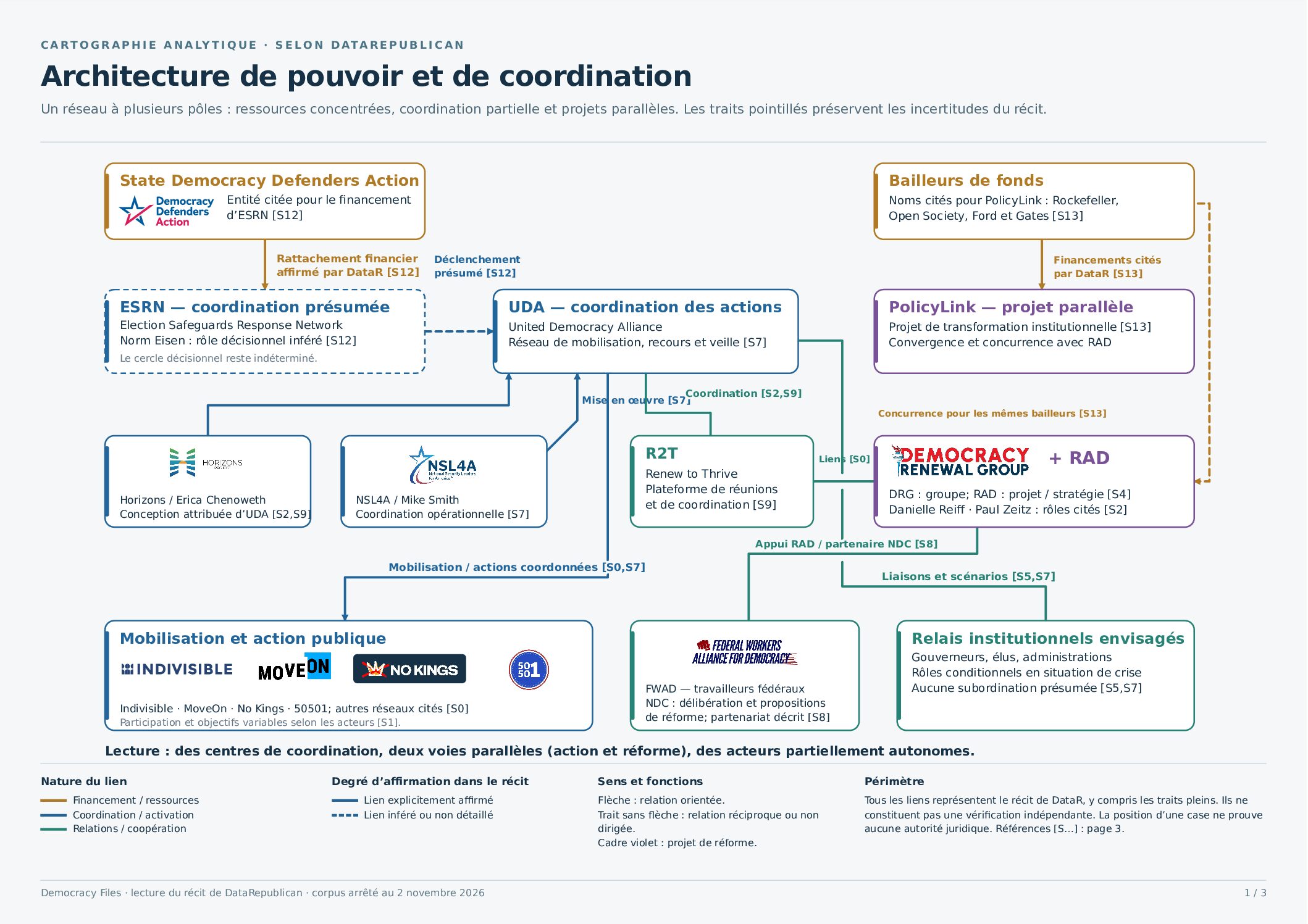
Les révolutions de couleur sont littéralement des coups d’État organisés de manière très structurée par des organisations qui doivent donner l’impression d’un mouvement organique, mais qui servent les intérêts de leurs bailleurs de fonds, c’est-à-dire des intérêts privés. Dans ce réseau organisationnel, Democracy Renewal Group (DGR), Renew American Democracy (RAD), United Democracy Alliance (UDA) et Horizons Project sont les organisations phares, à même de réaliser ce type d’actions. (voir le schéma à la fin de l’article)
Chacune d’entre elles possède son rôle spécifique et permet l’accomplissement de certains objectifs : de la mobilisation des masses, au renversement du gouvernement en place et à la configuration du nouvel ordre politique. Ainsi, Horizons Projet s’occuperait du cadre stratégique de résistance civile et de mobilisation (les manifestations et le chaos social); UDA s’occuperait de la coordination des organisations qui mettent cette mobilisation en œuvre; DGR et RAD seraient en charge de la préparation des transformations institutionnelles envisagées après la crise.
Des gouverneurs d’États démocrates ont même été approchées pour participer à ce qui serait légitime de qualifier d’acte insurrectionnel, voire séditieux. La Californie et l’Iowa auraient mentionné qu’elles participeraient uniquement si quelqu’un d’autre prenait les commandes. Quant à NSL4A, elle serait le bras opérationnel de l’UDA. L’organisation s’occuperait notamment de la mise en place d’une salle des opérations et du commandement logistique. Cette organisation prépare les scénarios de crise, notamment avec des exercices qui portent sur l’invocation éventuelle de l’Insurrection Act. Il établit les indicateurs pour transformer les « lignes rouges » en critères observables. Il organise une cellule de crise pour suivre de près la situation et les opérations.
Les « lignes rouges »
Invoquer l’Acte d’insurrection constitue une de ces « lignes rouges », à partir de laquelle ces organisations vont qualifier Trump de leader autoritaire et déclarer le président illégitime. La question décisive est de savoir si ces préparatifs visent à répondre à une crise anticipée ou à créer les conditions de son déclenchement. Une autre « ligne rouge » tient à la possibilité de retarder l’entrée en poste d’élus légitimement désignés.
Par exemple, si des allégations de fraudes électorales devaient être enquêtées et que des élus étaient empêchés d’exercer leur fonction politique. Il y a d’autres « lignes rouges » qui vont déclencher d’autres types de réponses, allant de la mobilisation de manifestants de manière massive dans un État ou un autre, jusqu’à des propositions de gouvernance transitoire. La notion clé ici est celle de seuil. Lorsqu’un seuil est franchi, une réponse du dispositif est activée.
La collaboration de l’appareil d’État
À travers la Federal Workers Alliance for Democracy, l’organisation cherche à s’assurer la collaboration d’une partie de l’appareil d’État qui pourrait résister à l’administration Trump. L’Alliance pourrait nuire à sa démarche de rétablir la loi et l’ordre, notamment en refusant d’obéir aux ordres qu’elle qualifierait d’illégaux, dans le but de ralentir ou d’arrêter le gouvernement durant cette période de crise.
Paul Zeitz, un coordinateur de RAD et un des protagonistes de premier plan dans cette histoire, précise dans les vidéos que l’Alliance s’occupe aussi des tables rondes de la campagne de délibération. Cela consiste en une tournée pour aller à la rencontre des participants de la société civile afin de discuter des changements qu’ils souhaiteraient implémenter dans le système politique américain en vue des élections de 2028. L’objectif de Zeitz n’est même pas opaque : il souhaite clairement une refonte de la Constitution américaine.
Les quatre B
Il y a quatre dimensions complémentaires à ce réseau de pouvoir et chaque organisation y joue son rôle selon la tâche qui lui est assignée, selon son B : Block, Bridge, Belong, Build. Selon DRG, cela correspond respectivement à bloquer les abus de pouvoir, établir des ponts entre les organisations, renforcer le sentiment d’appartenance collective et construire un système socio-politique renouvelé. Le texte de DGR soutient que les élections sont insuffisantes à renouveler la démocratie et que la pression citoyenne permet d’obtenir des transformations structurelles, ce qui est cohérent avec l’objectif de refonte constitutionnelle souhaitée par Zeitz
Le problème dans tout ça — lorsqu’on monte un réseau d’entités qui prévoit organiser des manifestations monstres en vue d’une refondation du système politique et de l’ordre constitutionnel — la ligne devient mince entre l’établissement d’un dispositif de renversement du gouvernement et une mobilisation citoyenne qui réclame des changements à l’intérieur des balises établies par la configuration politique actuelle. C’est exactement à propos de quoi Data Republican met en garde le public.
🚨🚨 THE ILLEGITIMACY PLAYBOOK / THE DEMOCRACY FILES: A PRIMER 🚨 I will be using this thread to track all drops, so bookmark it. I spent most of yesterday backing everything (now 312 gigabytes) up in various sources and getting the materials out to others. I also produced an AI video (below) to explain the whole thing to others are not on 𝕏 - feel free to distribute. Here's the primer: USAID, the foreign aid agency, had a democracy office. Inside the agency, it was called DRG. Officially, DRG administered "democracy assistance." They'd go inside countries they thought were sliding into authoritarianism and help the opposition there. That assistance included election monitoring, judicary support, independent media, and civil society building. You may have heard the term "color revolution." The model comes from Serbia in 2000, where trained student activists brought down Milosevic with the help of Western governments, after sustained protests. With the help of USAID's democracy office, this model was implemented in many other countries to topple governments: Georgia's "Rose Revolution" in 2003, Ukraine's "Orange Revolution" in 2004, and many more. Then last year, DOGE shut down USAID. But the USAID democracy office didn't stop. They formed a group called the Democracy Renewal Group, the same initials as their office (USAID Democracy, Human Rights, Governance). Their goal: apply their own playbook to the United States itself. This goal became a plan, called Renew American Democracy (RAD). It invoked the "4 B's" framework. Block - use lawfare and protests to make life harder for the Trump administration. Bridge & Belong - control dialogue and win people over. The final and most important B is Build. Build means redesigning the American government itself, and the crisis is the opening. In their own words: "We can take that breakdown moment and leverage it for a big structural reform, you know, refounding moment." - Danielle Reiff, DRG lead. Calls show DRG working alongside DSA on ideas of creating a different government, one that does away with the Constitution itself. DRG does not run the Block operations. They hand it to UDA, the United Democracy Alliance. One organizer calls it a "huge galaxy": lawsuits, street protests, non-cooperation. They list No Kings, Indivisible, MoveOn, 50501, and many other mega-activist NGOs among their members. Another organizer calls UDA Erica Chenoweth's project. Chenoweth is the Harvard professor behind the three-and-half-percent rule of regime change: get that share of a country's populace onto the streets, and historically, the movement wins. The UDA is very "hush-hush." They have no website, no roster, no filings. Then come the red lines: things the Trump administration could do, such as calling the Insurrection Act on protesters, that would mean that the federal government, in their words, "crosses the threshold into illegitimacy." Nobody voted on those lines. There was no public debate. These red lines were developed within secretive working groups, and in a paper addressed to governors and staff. In the words of Reiff/DRG: "So that if there is a red line crossed in terms of a Constitutional crisis, like everyone's already pre-organized. And so Mike Smith actually said, he goes, oh, you guys have the day after tomorrow plan." Cross a line, and the paper's options include states refusing to lend their resources to federal officials, and governors convening what it calls a "Third Continential Congress." Running the UDA's Insurrection Act working group: Rear Admiral Mike Smith (RET) of National Security Leaders of America (NSL4A). NSL4A is also credited with operationalizing UDA, the blocking operations. NSL4A consists of about 1,600 ex-officers, spies, diplomats. They're turning red lines into indicators and running a situation room to monitor them throughout the midterms and beyond. The NSL4A's lawyers told them to stop recording meetings in case of subpoenas. But the rest of the network continued to record. DRG works in conjunction with Renew to Thrive (R2T), which ended up accidentally publishing 400+ calls and thousands of documents. These calls and documents were never meant for our eyes, but it's them, on tape. Thousands of NGOs and billions of dollars are involved in this endeavor. Most of them believe they're saving democracy. The problem is that people who spent their careers deciding when other countries' governments had lost their legitimacy wrote that test for ours, in private, and planned for what comes after. Who decides when your government is legitimate?
— DataRepublican (small r) (@DataRepublican) October 22, 2026
La fuite
Autour du 15 octobre, Lisa Logan, une chercheuse indépendante, transmet à Data Republican un Google Drive public qui contient plusieurs liens sur les activités de Renew to Thrive (R2T) qui s’occupe justement de la coordination des communications entre toutes les entités. De fil en aiguille, elle a découvert des liens publics non répertoriés qui couvrent des enregistrements qui remontent jusqu’à trois ans.
Data Republican passera trois jours à télécharger les 312 gigabytes de données, dont de nombreuses rencontres en visio-conférences, dont plusieurs des participants à ces rencontres avaient requis qu’elles ne soient pas enregistrées.